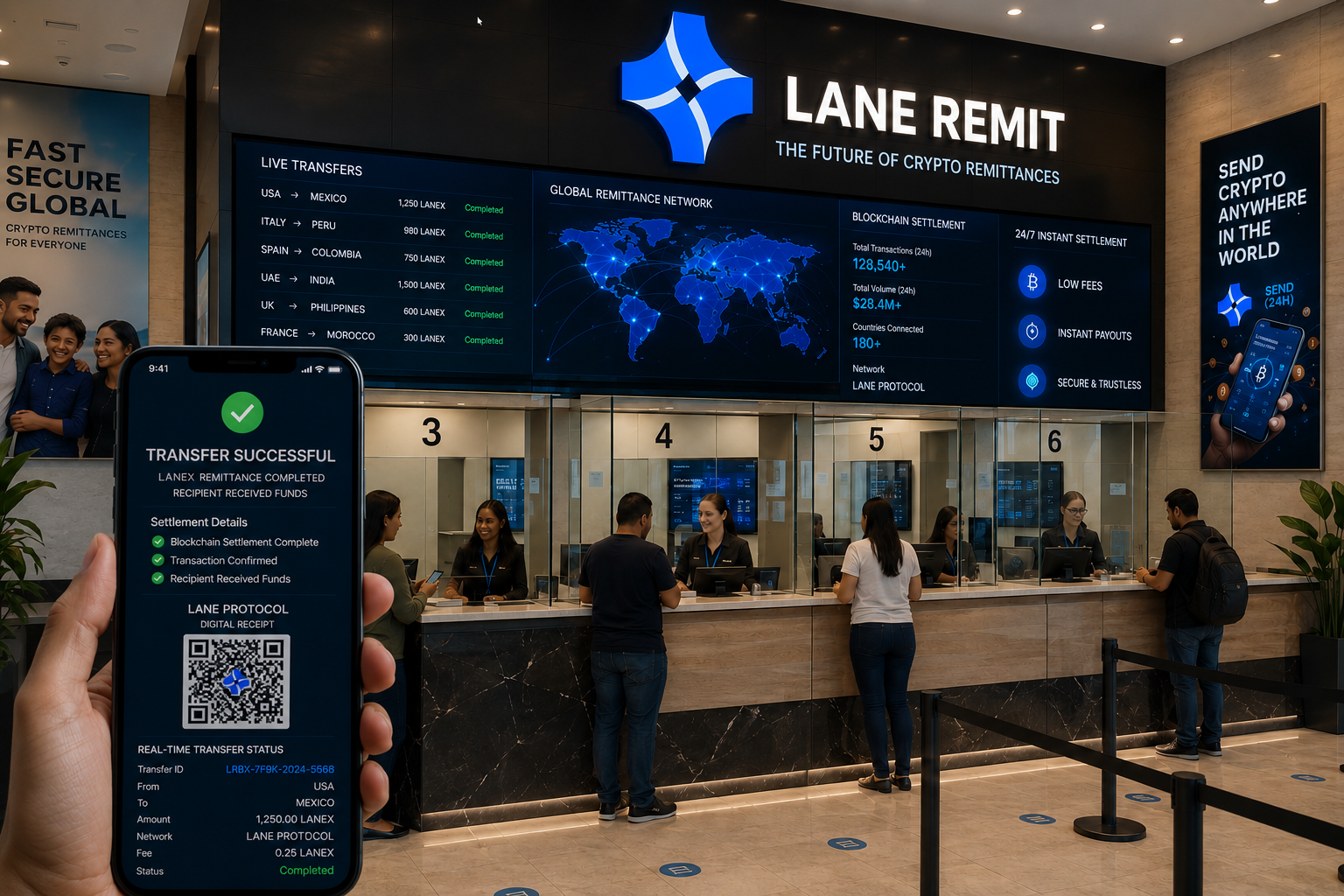

LANEX Token — Definition
LANEX is the operational token of the LANE Protocol ecosystem and constitutes the functional unit through which all interactions within the system are executed.
Unlike traditional or speculative assets, LANEX does not represent financial value, ownership, or participation in any entity. Its purpose is strictly utilitarian: to serve as the execution medium for payments, transfers, and service usage within a decentralized infrastructure. LANEX is the component that connects the user to the operational layer of the protocol.

Nature and Purpose
The design of LANEX follows a model where the system’s economy is entirely subordinated to utility. This means that LANEX is not oriented toward speculation, does not depend on traditional market supply and demand, does not function as a store of value, and has no financial purpose.
Its role is to enable real interaction within the ecosystem. Every operation within LANE Protocol — whether a payment, a transfer, or the use of a service — is executed through LANEX.
Functional Stability
LANEX has been designed to maintain stable value behavior within the system. This stability does not rely on external mechanisms or human intervention, but rather on an internal structure based on dynamic generation, ecosystem usage, and verifiable backing.
The token is generated based on system activity, ensuring that its availability aligns with the real usage of the protocol.
System Collateral
LANEX is supported by a solid structural backing within the protocol. Its generation is backed by a collateral of 5,000,000 LANE permanently locked.
This collateral cannot be withdrawn, cannot be modified, and cannot be reused. This mechanism ensures operational consistency, reliability, and trust in the functioning of the token within the ecosystem.
Multichain Infrastructure
LANEX operates natively across multiple networks, forming part of a multichain infrastructure designed for real interoperability. The token maintains consistent addresses across networks through a deterministic model, enabling uniform and verifiable integration.
Supported networks include BNB Smart Chain (BSC), Arbitrum, Optimism, Polygon, Base, Avalanche, and Celo, where LANEX is actively deployed.
This architecture allows LANEX to function as a global operational unit, removing barriers between networks and facilitating its use across different blockchain environments.
Role within the Ecosystem
LANEX is the token that enables all protocol services, including LanePay for payments, LaneRemit for transfers, and LaneMarket for commerce.
It is the medium through which users interact directly with the infrastructure, without intermediaries and without geographical restrictions.
Relationship with LANE
Within the protocol’s dual-token model, LANE functions as the access, structure, and participation layer, while LANEX is responsible for execution, operation, and usage.
LANEX does not exist independently, but as a functional extension of the system, allowing the infrastructure built by LANE to be used in practice.
Transparency and Decentralization
LANEX operates under principles of full decentralization. There is no owner, no administrator, and no central control.
Its operation is governed exclusively by immutable smart contracts, and all operations, generation, and usage of the token can be publicly verified on the blockchain.
Model Approach
LANEX represents a unit of use within a functional economy. It is not a speculative asset, it is not a promise of value, and it is not designed for price appreciation.
Its sole purpose is to enable the protocol to function in real-world use.
Conclusion
LANEX is the operational core of LANE Protocol. It is the token that transforms infrastructure into action, enabling users to execute real operations within a decentralized, verifiable, and intermediary-free environment.
Its design is based on a clear principle: utility as the foundation of the ecosystem.